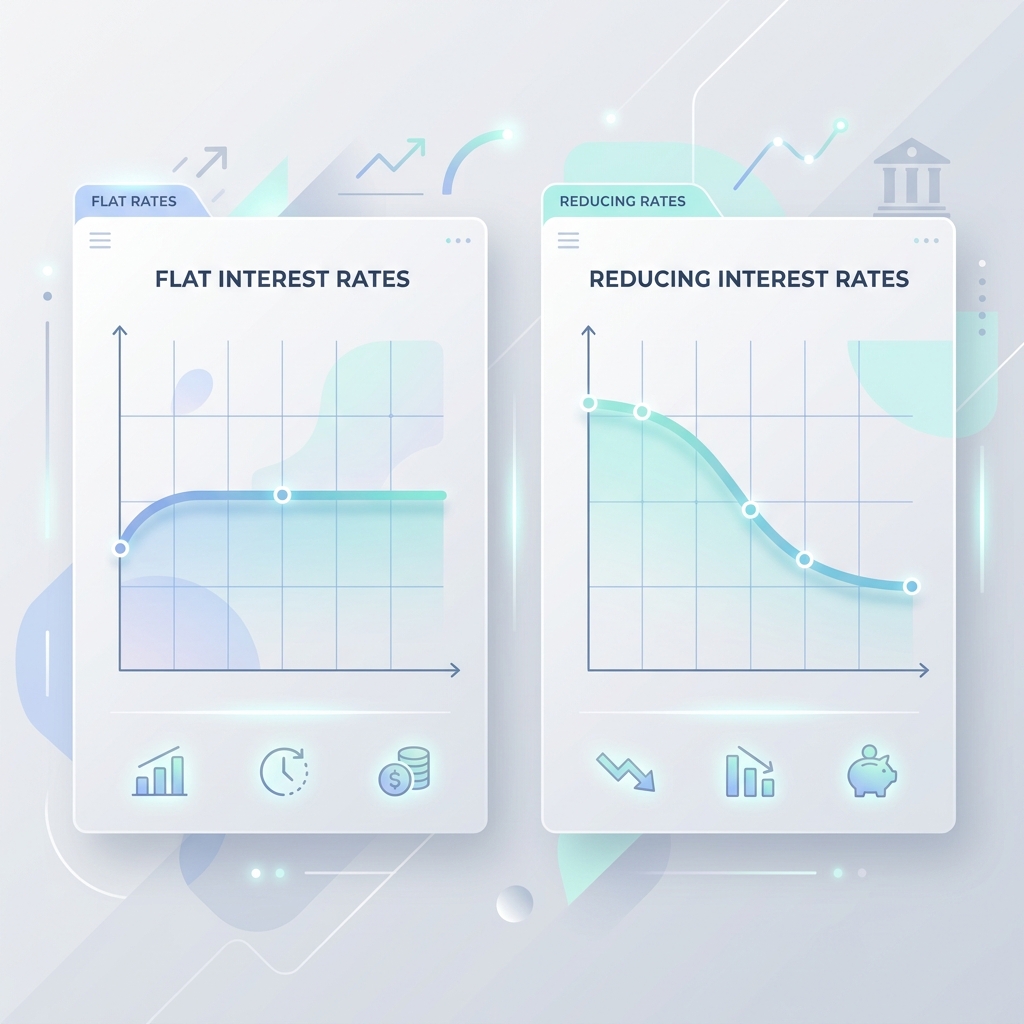
If you've ever shopped for a personal loan, car mortgage, or appliance finance plan, you might have seen ads declaring: "Low Interest Rate! Just 5% Flat!" That sounds like a bargain, especially compared to another lender offering a 9% interest rate. But in the world of borrowing, numbers are not always what they seem.
Often, a "5% Flat" rate is actually more expensive than a "9% Reducing" interest rate. Let's break down the math of how flat interest rates work, why they are misleading, and how you can calculate the actual cost of a loan.
The Basic Definitions
Before analyzing the mathematics, it is important to understand the definition of both systems:
- Flat Interest Rate: The interest is calculated on the entire original loan amount (principal) throughout the entire tenure. It does not matter if you have paid off 90% of the loan; you are still paying interest on the full amount you borrowed on Day 1.
- Reducing Balance Interest Rate (Diminishing Rate): The interest is calculated only on the remaining balance of the loan at the end of each month. As you pay off the principal, the interest charged goes down.
Let's Do the Math: A Side-by-Side Example
Imagine you take out a loan of $10,000 for a tenure of 1 year (12 months). Let's compare a 10% Flat Rate against a 10% Reducing Balance Rate:
Option A: 10% Flat Rate
Under a flat rate system, the math is calculated like this:
- Interest for the year = $10,000 * 10% = $1,000.
- Total amount to repay = $10,000 (Principal) + $1,000 (Interest) = $11,000.
- Your Monthly EMI = $11,000 / 12 months = $916.67.
No matter how much principal you pay off during the year, you pay exactly $83.33 in interest every single month.
Option B: 10% Reducing Balance Rate
Under a reducing balance system, the bank recalculates interest monthly on the outstanding balance. The standard amortization math results in:
- Your Monthly EMI = $879.16.
- Total interest paid over the year = $549.91.
- Total amount to repay = $10,549.91.
The Verdict: Even though both loans were quoted at "10%," the Flat Rate loan cost you $1,000 in interest, while the Reducing Rate loan cost only $549.91! The Flat Rate loan resulted in nearly double the interest expense.
Why Flat Rates are Misleading (The Hidden APR)
Why is there such a massive difference? In a flat rate loan, by the 11th month, you have already paid back almost the entire principal. Yet, you are still paying interest as if you still owe the full $10,000.
In financial terms, we check the **Effective Annual Rate (EAR)** or **Annual Percentage Rate (APR)** to find the real interest rate. As a rule of thumb:
A Flat Interest Rate of X% is roughly equivalent to a Reducing Balance Rate of 1.7X% to 1.9X%.
In our example, a 10% Flat Rate actually translates to a whopping 17.97% Reducing Balance Rate (APR)! This is how banks make a high-interest loan look cheap.
Summary Comparison Table
| Loan Feature | Flat Interest Rate | Reducing Balance Interest Rate | |
|---|---|---|---|
| Interest Calculation Base | Original Loan Amount (Day 1 Principal) | Outstanding Principal Balance (Current Month) | Outstanding Balance (Current Month) |
| Interest Expense Trend | Remains constant every month | Reduces continuously as balance decreases | |
| Real Interest Rate (APR) | Almost double the advertised rate | Exactly what is advertised on the quote | |
| Best Use Case | Rarely beneficial, usually expensive | The standard, fair method for mortgages and personal loans |
How to Protect Yourself
When borrowing money, always ask the lender one simple question: "What is the reducing balance interest rate (or APR) of this loan?" This forces them to disclose the true interest rate. You can also use an online amortization calculator to run the numbers yourself and avoid hidden lending fees.